
Half Moon Pose: The Second Posture of Hot 26and2
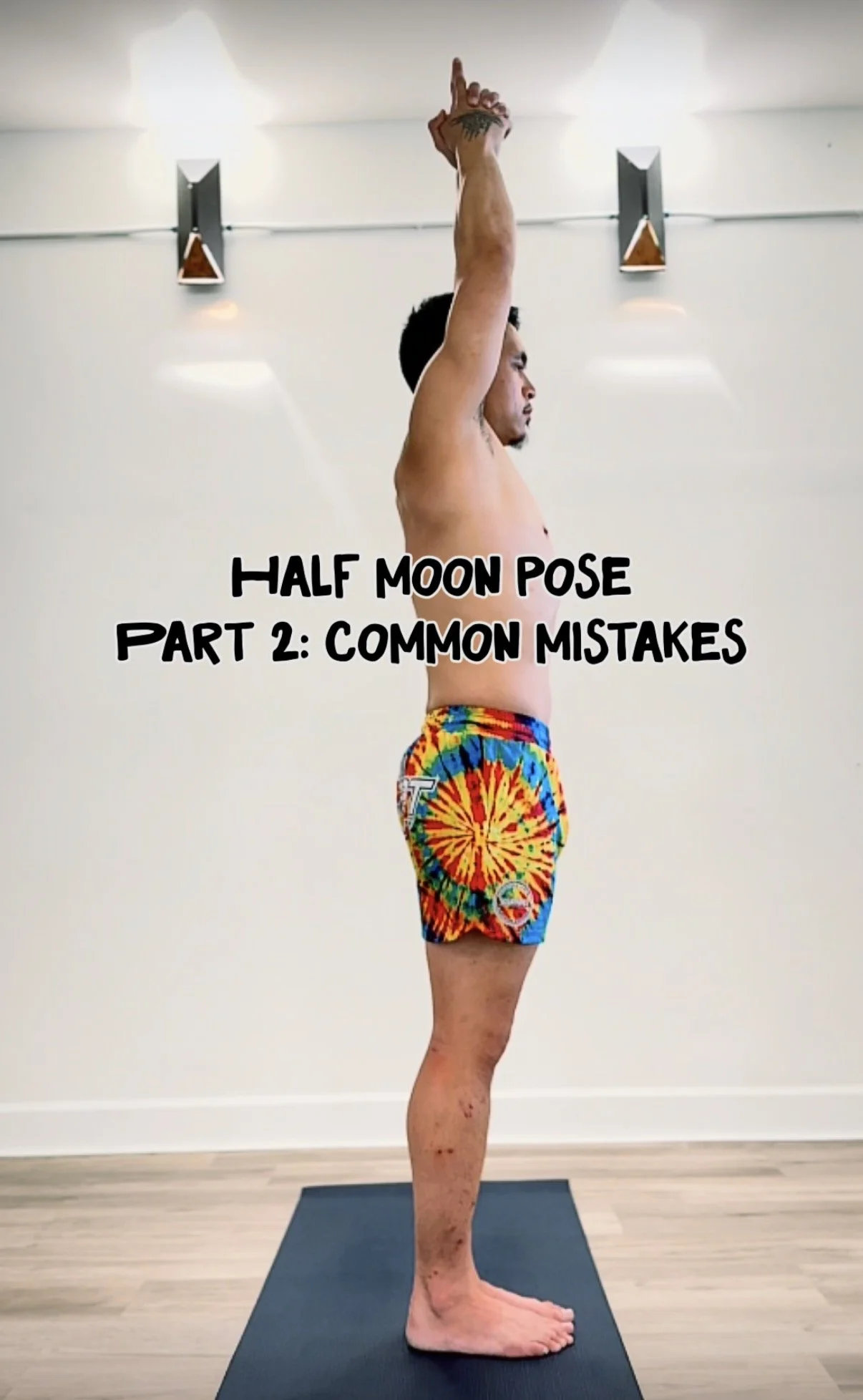
Coach Gino demonstrating Half Moon How to and Common Mistakes (follow on IG)
After Pranayama Standing Deep Breathing, the traditional Hot 26and2 sequence continues with Half Moon Pose with Hands to Feet Pose.
Half Moon Pose introduces the body to the stretching, strengthening, concentration, and controlled effort that will continue throughout the class. The posture moves the spine from side to side before progressing into a backward bend and, finally, a forward fold.
Although the traditional instructions provide a clear direction, every student’s Half Moon will look different.
The purpose is not to force the body into the deepest possible bend.
The purpose is to develop strength, alignment, breath awareness, patience, and control.
What Is Half Moon Pose?
Half Moon Pose is a standing posture performed with the feet together and the arms extended overhead.
The fingers are interlaced, the index fingers point upward, and the arms remain close to the ears. From this position, the body stretches upward before bending to the right and left.
The traditional posture is followed by a backward bend and Hands to Feet Pose, also known as Pada Hastasana.
Together, these movements begin working through several directions of the spine:
Side bending
Backward bending
Forward folding
Lengthening upward through the torso
Stabilizing through the legs and feet
Half Moon Pose may appear to be a simple side bend, but it requires coordination throughout the entire body.
The feet ground into the floor. The legs remain active. The hips stay organized. The abdominal muscles support the spine. The arms reach upward while the breath remains steady.
Why Does Half Moon Pose Come Near the Beginning of Class?
Half Moon Pose is the first traditional asana performed after the opening breathing exercise.
It begins introducing the physical and mental skills students will use throughout the rest of the Hot 26and2 sequence.
The posture asks students to:
Listen carefully to the teacher’s instructions
Maintain a stable foundation
Coordinate movement with breathing
Create length before bending
Engage the legs and abdominal muscles
Notice differences between the right and left sides
Remain patient while experiencing effort
Recognize when a movement needs to be reduced
The posture also gives students an early opportunity to observe how the body feels that day.
One side may feel more open than the other. The shoulders may feel tight. Balance may be different from the previous class. The breath may feel easy, restricted, or unfamiliar.
These observations are not failures.
They are information.
Potential Benefits of Half Moon Pose
When practiced with control and appropriate modifications, Half Moon Pose may support several aspects of a yoga practice.
Spinal mobility
The side bends move the spine laterally, while the backward bend and forward fold introduce additional directions of movement.
Students may gradually become more aware of where the spine moves easily and where it feels restricted.
A deeper bend is not automatically a healthier or more effective bend. The movement should remain controlled and appropriate for the student’s body.
Strength and stability
Half Moon Pose requires the legs, hips, abdomen, back, shoulders, and arms to work together.
The standing foundation helps students develop stability while the upper body moves away from its neutral position.
Body awareness
The posture can reveal habits that may otherwise go unnoticed.
A student may shift more weight into one foot, rotate one shoulder forward, hold the breath, bend the knees, or allow one hip to move out of position.
Becoming aware of these patterns is part of learning the posture.
Balance and concentration
Standing with the feet together while reaching overhead can challenge balance before the side bend even begins.
Students must remain attentive to the feet, legs, hips, arms, breath, and direction of movement.
Preparation for the sequence
Half Moon Pose begins preparing the body and mind for the standing postures that follow.
It establishes the practice of creating a strong foundation, listening to instructions, breathing through effort, and adjusting without panic.
How to Practice Half Moon Pose
1. Establish your foundation
Stand with your feet together in the traditional position.
Bring your heels and toes together as comfortably as possible. Distribute your weight across both feet rather than leaning heavily into one side.
If placing the feet together makes you feel unstable, separate them slightly.
Stability is more important than forcing the feet into a position that causes you to lose balance.
Keep your legs active without locking the knees aggressively.
2. Bring your arms overhead
Sweep your arms overhead and interlace your fingers.
Release the index fingers so they point upward. Cross your thumbs.
Stretch the arms toward the ceiling and bring them as close to the ears as your shoulders comfortably allow.
If the elbows bend or the arms move forward because of shoulder tightness, reduce the effort. Do not force the shoulders into a range of motion they do not currently have.
3. Stretch upward
Before bending sideways, create length through the body.
Ground through the feet while reaching upward through the hands. Imagine creating space between the ribs, waist, and hips.
The upward stretch is an important part of the posture.
Lengthen first.
Then bend.
4. Bend to the right
Keeping both feet grounded, begin bending your body to the right.
Move gradually rather than dropping suddenly into the side bend.
Continue reaching through the fingertips. Keep the arms close to the ears without squeezing the head or neck.
Try to keep the hips organized rather than twisting the chest or turning the body toward the floor.
Breathe steadily and work within a range you can control.
5. Return to the center
Use the strength of your legs and torso to return slowly to an upright position.
Stretch upward again before changing sides.
Avoid swinging or using momentum.
6. Bend to the left
Repeat the movement on the left side.
The second side may feel different from the first. Do not force both sides to look identical.
Observe the difference without judging it.
Continue breathing and maintain the strongest comfortable foundation available to you.
Common Challenges in Half Moon Pose
Tight shoulders
Students with limited shoulder mobility may have difficulty straightening the elbows or bringing the arms beside the ears.
Helpful modifications may include:
Keeping the arms slightly forward
Allowing a small bend in the elbows
Separating the hands instead of interlacing the fingers
Lowering the arms if numbness or tingling develops
Using a smaller side bend
Relaxing unnecessary tension in the neck and jaw
The arms do not need to be perfectly straight for the student to begin learning the posture.
Lower-back discomfort
Some students may feel compression or discomfort in the lower back, particularly when they collapse into the side bend instead of lengthening first.
Try reducing the depth of the bend and creating more upward reach.
Keep the legs active and gently engage the abdomen. Avoid pushing the hips dramatically in the opposite direction.
Stop if the posture causes sharp, pinching, or radiating pain.
Balance difficulties
Standing with the feet together can create instability.
Students may:
Separate the feet slightly
Keep the knees softly unlocked
Focus the eyes on one stationary point
Practice near a wall
Reduce the depth of the side bend
Return to the center whenever balance feels unsafe
Using support is not a failure. It can help the student practice with greater awareness and control.
Uneven hips or shoulders
Human bodies are not perfectly symmetrical.
Differences in strength, mobility, injuries, spinal structure, scoliosis, or daily habits may cause one hip or shoulder to move differently.
Alignment instructions provide a direction, but students should not force the body into visual symmetry at the expense of comfort or safety.
Modifications for Scoliosis or Spinal Limitations
Scoliosis and other spinal conditions can affect the shoulders, rib cage, waist, hips, balance, and breathing pattern.
A student may notice that:
One side bends more easily
One shoulder remains higher
One arm moves forward
One side of the rib cage feels more restricted
The hips shift differently in each direction
Standing with the feet together feels unstable
Helpful modifications may include:
Separating the feet for stability
Using a smaller range of motion
Keeping the arms lower
Bending only as far as breathing remains comfortable
Practicing near a wall
Avoiding pressure to make both sides identical
Returning to neutral between movements
Focusing on length rather than depth
Students with spinal fusion, recent surgery, nerve symptoms, persistent pain, or significant spinal conditions should seek individualized guidance from an appropriate healthcare professional.
Advice for Beginners
Half Moon Pose can feel demanding during a first Hot 26and2 class.
A beginner is learning how to stand, position the hands, stretch upward, engage the legs, breathe, listen, balance, and bend—all at the same time.
It is normal for the posture to feel unfamiliar.
Beginners may:
Keep the feet slightly apart
Bend only a few inches
Allow the elbows to soften
Lower the arms when necessary
Come out of the posture early
Pause and breathe normally
Watch part of the posture before trying again
Ask the teacher for clarification after class
The first goal is not to produce a perfect shape.
The first goal is to learn the direction of the posture.
Understanding, strength, mobility, and confidence can develop through consistent practice.
Effort Is Different From Pain
Yoga may involve muscular effort, stretching sensations, heat, fatigue, and movements that feel unfamiliar.
However, students should reduce the movement or stop if they experience:
Sharp or sudden pain
Pinching in the spine or shoulders
Tingling or numbness
Pain traveling into an arm or leg
Dizziness or feeling faint
Chest pain
Visual disturbances
Severe shortness of breath
Loss of balance that feels unsafe
Any sensation that feels alarming
Listening to the body is not separate from practicing yoga.
It is part of the practice.
Consistency Is More Important Than Depth
Progress in Half Moon Pose does not always mean bending farther.
Progress may mean:
Standing with better balance
Breathing more steadily
Creating more length before bending
Keeping the legs active
Reducing tension in the shoulders
Recognizing when to modify
Moving more slowly and deliberately
Feeling less frustrated by differences between the two sides
Practicing without forcing the body
Mobility and strength develop differently for every student.
The body often responds better to patient repetition than to aggression.
You do not need to achieve the deepest expression of the posture today.
The Role of the Teacher
A teacher can explain the traditional technique, offer alignment cues, observe visible movement, and suggest possible modifications.
However, a teacher cannot feel what is happening inside a student’s spine, joints, muscles, or nervous system.
Students should communicate relevant injuries, surgeries, pregnancy, dizziness, chronic pain, scoliosis, balance concerns, and other physical limitations.
Teachers should guide students toward the posture while respecting individual structure and experience.
The traditional instructions give the practice direction.
The student’s body provides information.
Both matter.
Final Thoughts
Half Moon Pose is the first traditional asana of the Hot 26and2 sequence.
It teaches students to ground through the feet, create length through the spine, move with control, concentrate through effort, and observe the body without immediately judging it.
The posture gives us a direction, but progress does not require force.
Stand firmly.
Reach upward.
Breathe steadily.
Move with control.
Respect what your body is communicating today.
The practice is not about creating the biggest side bend as quickly as possible.
It is about returning, listening, learning, and allowing the posture to develop over time.
This article is intended for general yoga education. It is not a substitute for medical advice, diagnosis, physical therapy, or individualized treatment.
Experience Hot 26and2 at The MATS Daly City
Ready to experience the practice for yourself? Visit The MATS in Daly City and explore our welcoming variety of movement classes for different experience levels.
Our schedule includes Hot 26and2, hot yoga, warm and heated yoga, non-heated yoga, meditation, and fitness classes designed to help you build strength, improve flexibility, reduce stress, and feel more connected to your body.
Whether you are completely new to yoga or returning to a consistent practice, our instructors will guide you while encouraging you to listen to your body and move at your own pace.
Come practice with us at The MATS Daly City and find the class that feels right for you. View our class schedule and reserve your spot today.
