
Why Are We So Afraid to Bend Backward?
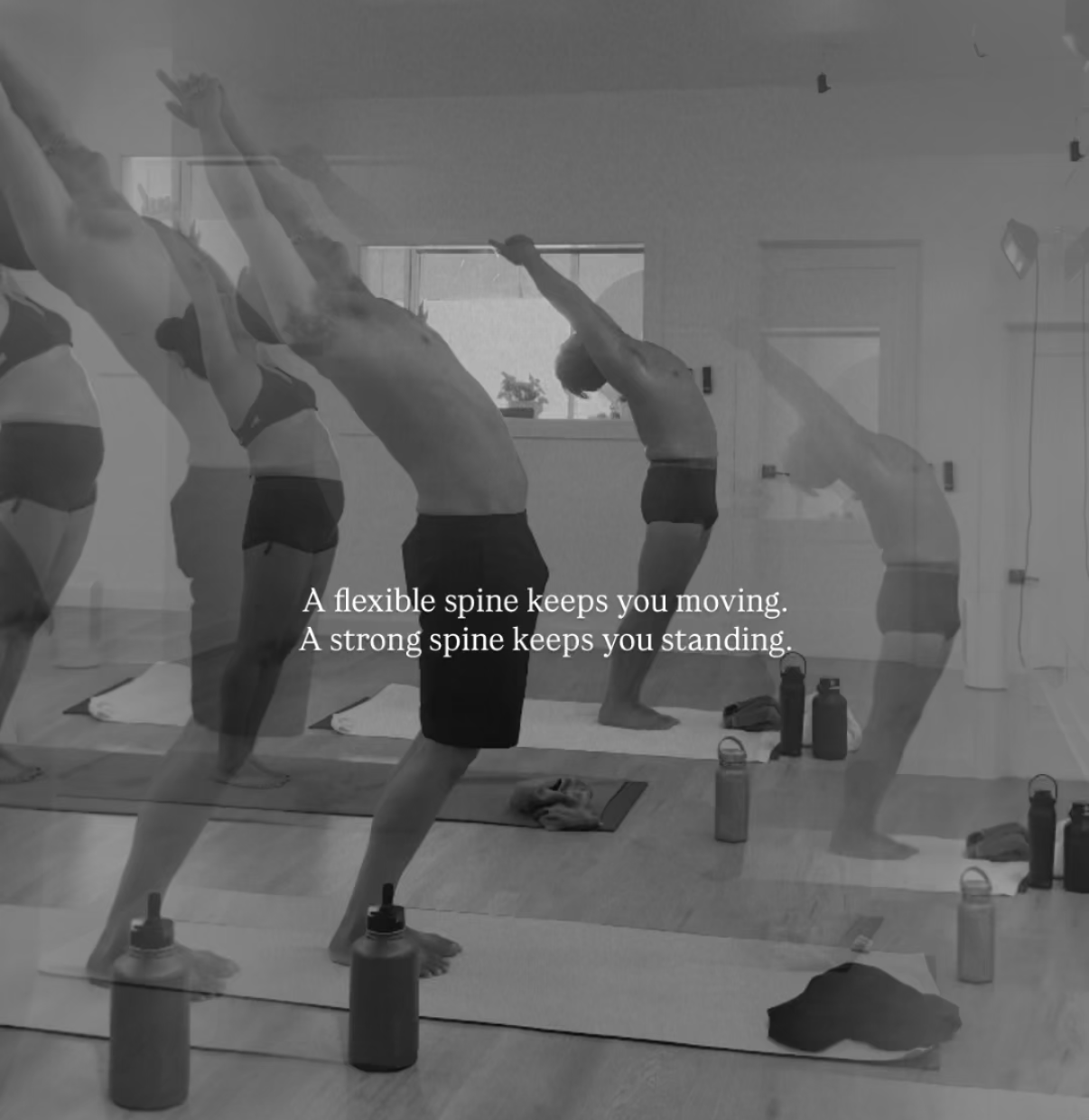
Hot 26and2 Yoga class at The MATS Daly City, September 15, 2026, 4pm
The Hot 26&2 Backbend—and Why Your Spine Needs More Than Forward Motion
“Go back… way back… more back…”
And suddenly, half the room is thinking:
Absolutely not.
There’s something about a backbend that brings up fear almost immediately.
What if I hurt my back?
What if I fall?
I’m not flexible enough.
My back doesn’t bend that way.
Isn’t backbending bad for your spine?
For many students, the backbend in Hot 26&2 is one of the most intimidating parts of the entire class.
But here’s the interesting part:
Your spine was designed to move in more than one direction.
We spend so much of our everyday lives moving forward—sitting at desks, driving, looking down at our phones, cooking, working on computers, picking things up, and generally living with our arms and attention in front of us.
Then we walk into the hot room, lift our chest, look back and ask the spine to move in the opposite direction.
No wonder it feels unfamiliar.
But unfamiliar doesn’t automatically mean unsafe.
Backbending Is a Movement, Not a Trick
A backbend can look dramatic, especially when you see someone with years of practice dropping deeply backward.
But the purpose isn't to see how far you can go.
The purpose is to move the spine into extension with control.
Spinal extension is a normal part of human movement. In a properly taught backbend, the goal is not to collapse into the lower back or force yourself into the deepest shape possible. You’re learning to distribute the movement through the body while maintaining strength, control and breath.
That means your backbend does not need to look like anyone else’s.
For one person, it may be a deep arc.
For another, it may simply be lifting the chest, reaching upward and beginning to look back.
Both are backbending.
Why Are People So Scared of It?
Because we can't see where we're going.
Think about it.
When you bend forward, the floor is right there. You can see your legs. You can see your feet. Your brain has plenty of visual information about where your body is in space.
When you bend backward, you're moving toward something you cannot see.
That can feel vulnerable.
Then add tight shoulders, a stiff upper back, years of sitting, previous experiences with back pain, or simply the belief that “I have a bad back,” and the nervous system may immediately respond with hesitation.
Sometimes the first thing we're training in a backbend isn't flexibility.
It's trust.
Trusting your breath.
Trusting your strength.
Trusting the technique.
And learning the difference between the intensity of a new movement and a signal from your body telling you to stop.
Why Backbend in Hot 26&2?
The standing backbend comes near the beginning of the Hot 26&2 practice, as part of Half Moon Pose.
After reaching upward and moving the spine from side to side, we change direction.
We lift.
We lengthen.
We open the chest.
And then we begin to go backward.
A controlled backbend works the muscles that support spinal extension while challenging mobility through areas such as the shoulders, chest, upper back and hips.
That last part matters.
A healthy-looking backbend isn't simply “bend your lower back more.”
Ideally, the shape is shared throughout the body.
The chest lifts.
The shoulders open.
The upper and middle back participate.
The hips extend.
The legs stay strong.
The body works together.
Your Lower Back Shouldn't Have to Do Everything
This is one of the most important lessons about backbending.
When the upper back and shoulders are stiff, students sometimes compensate by trying to get all of the movement from the lumbar spine—the lower back.
That's not the goal.
Instead of thinking:
“How far can I bend?”
Try thinking:
“How long can I stay as I bend?”
Reach upward before reaching backward.
Create length.
Keep the legs active.
Lift through the chest.
Then allow the backbend to develop from there.
Depth comes later.
Technique comes first.
But What If My Back Is Really Stiff?
Then your backbend may be small.
And that's completely okay.
Yoga isn't asking you to arrive at someone else's range of motion.
It's asking you to work intelligently with the body you have today.
Someone who has practiced for 20 years should not necessarily look the same as someone taking their fifth class. And your own backbend may look different from one day to another.
Some days your body opens easily.
Other days it says, “This is where we're stopping today.”
Listening to that information is part of the practice.
And if you have an injury, osteoporosis, a spinal condition, are pregnant, are recovering from surgery, or have unexplained or significant back pain, your approach may need to be modified with guidance from an appropriate healthcare professional and an experienced teacher.
The Goal Isn't the Deepest Backbend in the Room
This may be the biggest misconception of all.
The person bending the farthest isn't necessarily receiving the greatest benefit.
A beautiful backbend isn't defined by how close your hands get to the floor.
It's defined by how you move into it.
Can you breathe?
Can you stay strong?
Can you maintain control?
Can you recognize the difference between productive effort and pain?
Can you respect your body enough not to force it?
Those questions matter much more than depth.
Maybe That's Why Backbending Feels So Powerful
There's something very different about moving backward.
Most of our day happens in front of us.
We look forward.
Reach forward.
Think forward.
Protect the front of the body.
A backbend asks us to do something different.
Lift the heart.
Open the chest.
Look somewhere we can't normally see.
And move into a space that initially feels uncertain.
That doesn't mean we throw caution away.
It means we practice courage with awareness.
Little by little, class by class, the movement that once felt frightening can begin to feel familiar.
The body learns.
The nervous system learns.
And we learn.
So the next time your teacher says:
“Arms back. Look back. Go back…”
Don't worry about how far the person next to you is going.
Reach up.
Breathe.
Stay strong.
And explore the backbend that belongs to your body today.
Because the goal isn't to prove how flexible your spine is.
The goal is to keep giving it the opportunity to move.
Hot 26&2 Practice Note
Never force a backbend or push through sharp, pinching, radiating or unusual pain. Backbending should be progressive and controlled. Individual anatomy, injuries, pregnancy and medical conditions can change what is appropriate for each person. When in doubt, modify and speak with your teacher and healthcare provider.
Experience Hot 26and2 at The MATS Daly City
Ready to experience the practice for yourself? Visit The MATS in Daly City and explore our welcoming variety of movement classes for different experience levels.
Our schedule includes Hot 26and2, hot yoga, warm and heated yoga, non-heated yoga, meditation, and fitness classes designed to help you build strength, improve flexibility, reduce stress, and feel more connected to your body.
Whether you are completely new to yoga or returning to a consistent practice, our instructors will guide you while encouraging you to listen to your body and move at your own pace.
Come practice with us at The MATS Daly City and find the class that feels right for you. View our class schedule and reserve your spot today.
