
The Dialogue Is Not the Practice: Learning to Listen to Your Body in Original Hot Yoga
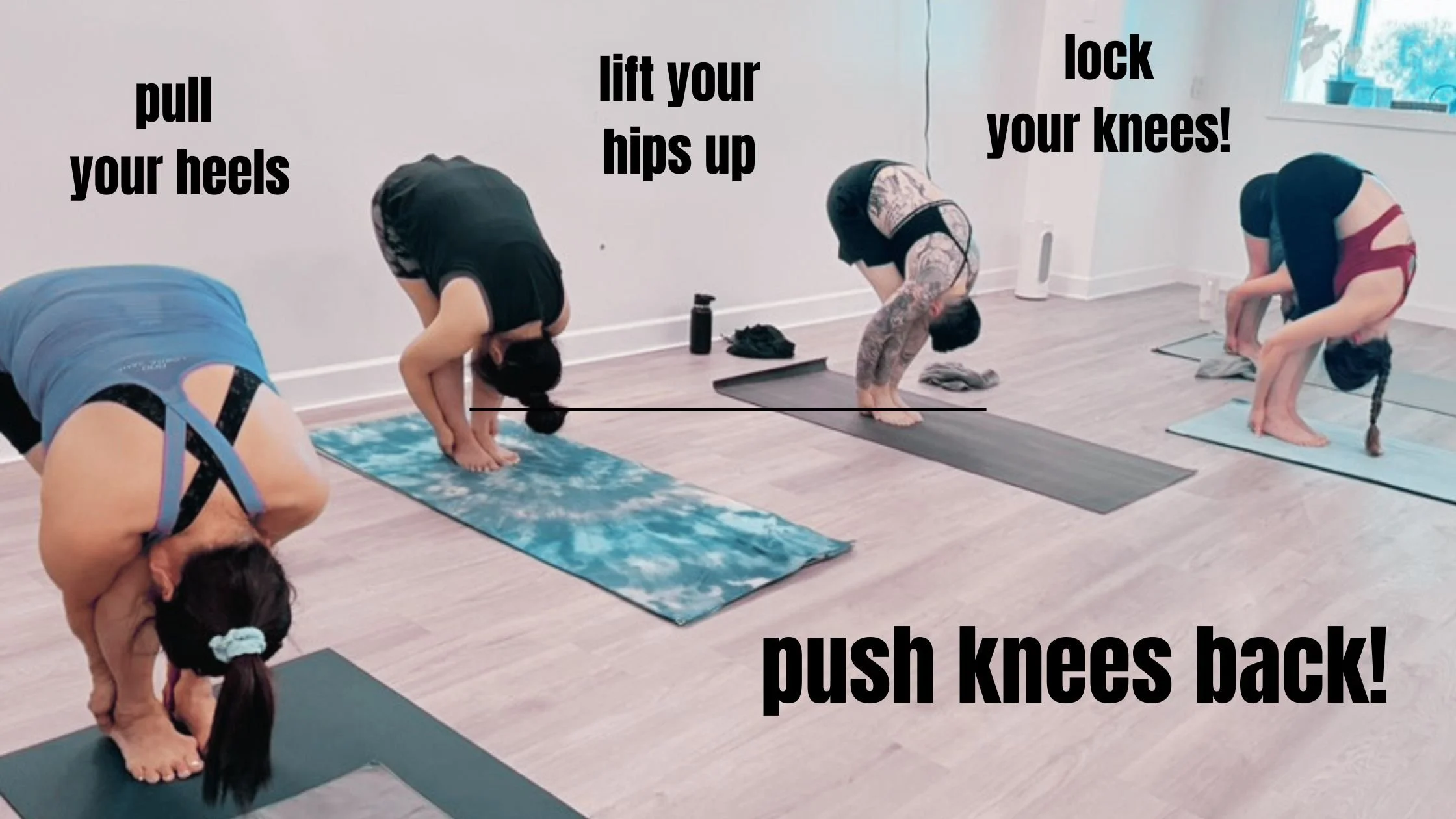
Pada Hastasana (Hands-to-Feet Pose), Posture #2 of The Original Hot Yoga, Hot 26and2 aka Bikram Yoga.
If you've ever taken an Original Hot Yoga (26&2) class, you've probably heard phrases like:
"Lock your knees."
"Push."
"Grab your heels."
"Touch the floor."
"Touch the ceiling."
"Bring your hips forward."
To someone new to the practice, these instructions can sound intense.
Sometimes they sound impossible.
Sometimes they even sound contradictory to what your body is telling you.
So what should you do?
Listen to your body.
That may sound surprising coming from a teacher of Original Hot Yoga, but it's one of the most important lessons we can offer.
The Dialogue Is a Guide, Not a Requirement
The dialogue in Original Hot Yoga serves many purposes.
It helps maintain the rhythm of class. It teaches alignment. It keeps students focused. It encourages effort when the mind wants to quit.
Most importantly, it gives students something to work toward.
But the dialogue is not a list of demands.
When a teacher says, "Grab your heels," it doesn't mean you must grab your heels today.
When a teacher says, "Touch the floor," it doesn't mean your body is ready to touch the floor today.
When a teacher says, "Bring your hips forward," it doesn't mean forcing your body into a position that feels unsafe.
The instruction is an invitation to explore your potential—not an order to ignore your body's signals.
Understanding the Intention Behind the Words
One of the challenges of any yoga practice is learning the difference between the words being spoken and the purpose behind them.
Take the phrase:
"Lock your knees."
This may be one of the most misunderstood instructions in Original Hot Yoga.
Many people assume it means forcing the knees backward or creating tension in the joint.
That is not what we mean.
As Hot Yoga teachers, we're encouraging students to straighten the legs and activate the quadriceps.
When the thigh muscles engage, the kneecaps lift and the legs become strong and stable.
The purpose is not to stress the knees.
The purpose is to create muscular engagement that helps support and protect the joints.
In many postures, an inactive leg can actually place more stress on the knees than an engaged one.
The instruction is less about locking and more about activating.
Less about force and more about stability.
Discipline Is Different Than Force
The Original Hot Yoga dialogue can sound intense.
For some students, that intensity is exactly what they need.
It helps them stay focused when their mind wants to quit.
It helps them discover that they are capable of more than they thought.
But there is an important difference between discipline and force.
Discipline says:
"I can try a little more."
Force says:
"I don't care what my body is telling me."
Discipline builds strength.
Force often leads to frustration, burnout, or injury.
A healthy yoga practice requires both effort and awareness.
The challenge is learning how to balance the two.
Every Body Is Different
No two practitioners are the same.
Some students are naturally flexible.
Others are naturally strong.
Some have hypermobile joints.
Some are recovering from injuries or surgeries.
Some need more encouragement.
Others need permission to slow down.
This is why the same instruction may look different from one person to another.
The goal is not to make every posture look the same.
The goal is to help each student practice safely and mindfully within their own body.
The Most Important Voice in the Room
As teachers, we guide.
We educate.
We motivate.
Sometimes we challenge.
But the most important voice in the room isn't ours.
It's yours.
Your breath.
Your awareness.
Your body's feedback.
The dialogue may move quickly.
The energy may feel intense.
The room may feel challenging.
But you are always encouraged to move with awareness and make choices that support your body.
Sometimes that means going deeper.
Sometimes that means staying exactly where you are.
Both can be the right choice.
The Real Goal of the Practice
The goal of Original Hot Yoga is not to create the deepest backbend.
It's not touching your head to your knee.
It's not grabbing your heels.
It's not making the posture look perfect.
The goal is awareness.
Awareness of your body.
Awareness of your breath.
Awareness of your thoughts.
Awareness of how you respond when things become difficult.
The dialogue is there to motivate you.
The postures are there to challenge you.
But the real practice is learning to listen.
Listen to your teacher.
Trust your body.
And over time, learn the wisdom of knowing when to push, when to pause, and when to simply breathe.
That's yoga.
